ADG Rajendra Chaudhary warned against western fast food
Said millet is gluten free, high in protein and good for health
Chandigarh//Ludhiana:11th January 2023: (Kartika Singh//Punjab Screen Desk)::
The Ministry of Information and Broadcasting in collaboration with Kheti Virasat Mission organized a Media Interaction and Millet Lunch at Ludhiana Club today. In today's era, it was a historic event to find solutions to the problems that our society is facing related to food grains and agriculture, in which very relevant and deep things became the subject of discussion.
The Government of India sponsored the proposal for the International Year of Millets (IYM) 2023, which was approved by the United Nations General Assembly (UNGA). Indian Prime Minister Mr. Narendra Modi has also expressed his desire to call IYM 2023 a "people's movement" and for India to become a "global hub for millets". This movement is being spearheaded by PIB Chandigarh in the region. He has also organized Millet Lunch for the local media in Tarn Taran and Chandigarh to encourage the media to give more media space to Bajra and its promotion.
Discussing the health problems that have arisen in the present times, the ADG of PIB Chandigarh Mr. Rajendra Chowdhary revealed very interesting facts. He said during the conversation that “due to the adoption of western fast food culture, today's young generation is facing many health-related problems from an early age. Millets can aid in the fight against various health problems. Millets are gluten-free, high in protein, and have a low glycemic index. Thus, they can also help with weight loss.”
"Bajra is beneficial for consumers and farmers as well as for the environment," he added. He continued “Bajra requires less water and electricity to grow. Millets help in fighting against many diseases like obesity, diabetes, anemia, hormonal imbalance, high cholesterol etc., thereby enabling the consumer to lead a healthy life. Consequently, it is an excellent source of balanced nutrients.” The purpose of today's event is to create awareness among the media about millets. As a result, consumption will also increase, which will increase demand.
Special speaker at the event, Mr. Umendra Dutt, Executive Director, Kheti Virasat Mission said: “Bajra is no longer considered a fringe crop. They are in competition with the cyclical cultivation of rice and wheat. Additionally, they reduce our carbon footprint. can reduce." Discussing stubble burning, he said, “Bajra stalk is very good food for cattle.” "Farmers do not burn millet stalks because of their use as cattle feed. This could also be the answer to the issue of stubble burning in Punjab," he said.
Mr. Rasinder Singh, a Bajra farmer from Jagraon also spoke about his experiences on the occasion and said that Bajra is also an integral part of the G-20 meetings and the delegates were invited to taste it, meet farmers and start-ups related to Bajra. The true experience of Bajra will be given through interactive sessions with Dr. He also said, "On the occasion of the International Year of Millets 2023, the government's efforts to give due attention to millets are being rightly noticed, and the present meeting intends to do the same."
Thoroughly suggested solutions to each aspect of difficulties
PM’s address during the ‘Chintan Shivir’
PM Addressed the Meeting of Home Ministers of States via video conferencing
New Delhi: 28th october 2022: (PIB//Punjab ScreenBureau)::
Namaskar!
My colleague in the Union Cabinet Shri Amit Shah, Chief Ministers, Home Ministers, Director Generals of Police of different states, senior officials of the Ministry of Home Affairs, all other dignitaries, ladies and gentlemen! There is a festive atmosphere in the country these days. The countrymen have celebrated many festivals, including Onam, Eid, Dussehra, Durga Puja and Deepawali, with peace and harmony. Now there are many other forthcoming festivals, including Chhath Puja. In the wake of various challenges, the strengthening of the unity of the country during these festivals is also a reflection of your preparedness. Even though law and order is the responsibility of the states under the Constitution, it is largely related to the unity and integrity of the country. This ‘chintan shivir’ (brainstorming session) of home ministers being held in Surajkund is also a good example of cooperative federalism. Every state should learn from each other, take inspiration from each other and work together for the betterment of the country. This is the spirit of the Constitution and it is also our responsibility towards the countrymen.
Friends,
The ‘Amrit Kaal’ of independence is before us. The next 25 years will lead to the ‘Amrit’ generation of the country. This ‘Amrit’ generation will be created by imbibing the resolutions of ‘Panch Pranas’ (five pledges). Building a developed India, freedom from every concept of slavery, being proud of our heritage, unity and solidarity and most importantly civic duty -- you all understand the importance of these five pledges. This is a colossal resolve, which can be fulfilled only by ‘Sabka Prayas’ (efforts of everyone). Methods may be different, our paths and priorities may be different, but these ‘Panch Pranas' should be the inspiration of our governance in every state of the country. India's potential will be vastly expanded when these are at the core of good governance. When the potential of the country will increase, then the power of every citizen, every family of the country, will increase. This is good governance, which every state of the country has to ensure to the last person standing in the last row of society. You all have a very important role in this regard.
Friends,
Most of you who are attending this ‘shivir’ are either leading your state, or are directly responsible for law and order. Law and order is directly related to the development of the state. Therefore, your decisions, policies and practices are very important in creating a conducive environment for development in the states.
Friends,
It is equally important for the entire law and order system to be reliable and its perception among the public. You have seen that NDRF and SDRF have emerged as a major force in the event of any natural calamity. Their appearance ahead of any crisis has created a belief among the countrymen that the situation will now be under control and we should abide by them and we will suffer less if we listen to them. See for yourself, who all are there in NDRF and SDRF? They are your colleagues. They are jawans of the armed forces. But, there is a kind of respect for them in the society. As soon as the NDRF-SDRF team reaches the disaster-hit area, people feel assured that there is an expert team which will take care of the situation.
Friends,
As soon as the police reach any place of crime, there is a feeling among the people that the government has arrived. We saw tremendous improvement in the credibility of the police during the Corona period. Policemen were helping the needy, arranging necessary resources and even putting their own lives at stake. That is, there is no dearth as far as devotion to duty is concerned. However, there is also a need to maintain positive perception. Therefore, there should be a relentless process from top to bottom to motivate the police force and plan accordingly. They should be guided regularly on every little issue to prevent any wrongdoing.
Friends,
We have to understand one more thing. Now law and order is no longer confined within the purview of any one state. Now crimes are happening at the inter-state and international level. With the help of technology, criminals sitting in one state have the audacity to commit horrific crimes in another state. Criminals outside the borders of the country are also misusing technology. Therefore, coordination between agencies of every state and coordination between central and state agencies is very important. You would recall that I reiterated this during the DGP conference that there should be periodical assessment of problems of adjoining districts of two states and they should work together. It will lead to the creation of a new power. Sometimes central agencies have to conduct investigations in several states simultaneously and they have to go to other countries also. Therefore, it is the responsibility of every state to extend full cooperation to any state or Central agency. All the agencies should cooperate with each other. One should not dwell unnecessarily on the power and domain of any agency. Sometimes, we find that an FIR is not registered due to the confusion over the area of crime and the domain of the police station. These things are not only limited to police or police stations. It happens between states also. It also happens between the Centre and the states. It also happens between agencies of India and abroad. Therefore, coordination, compilation and cooperation at all levels are very important for our own efficiency and outcome as well as providing security to the common citizen of the country. Every state stands to benefit if there is cooperation at all levels.
Friends,
We need to keep working on technology to combat cybercrime or the use of drone technology in smuggling weapons and drugs. You see, it is an era of 5G. Now along with the benefits of 5G, awareness at that level will also be necessary. 5G is going to improve the performance of technologies like facial recognition technology, automatic number-plate recognition technology, drones and CCTV manifolds. The more rapidly we move forward, the criminal world is equally catching up due to globalization. They are equally adept at technology. It means that we will have to plan ten steps ahead of them. We will have to work with greater urgency to make our law and order system smart.
Friends,
I would urge everyone not to let the budget come in the use of technology. Therefore, I urge all the respected Chief Ministers and Home Ministers to make a team on this issue and deliberate seriously how technology savvy the criminal world is becoming and how the technology available with us can provide security to our people. The budget regarding this can be met by saving unnecessary expenses. The better use of technology not only strengthens the entire police set-up, but it also leads to trust among common citizens regarding their own security. Technology helps in crime prevention and also in crime detection. It is also very useful in the investigation of crimes. You see, a number of criminals are being arrested today because of CCTV. Modern command and control systems created in cities under the Smart City Campaign are also helping a lot.
Friends,
The Central Government has also launched the Police Technology Mission for the development of new technologies. Several states are also working at their level in this regard. But experience tells us that technology becomes redundant due to different experiments at different levels and hence our energy is also wasted. Often investigation material remains with the concerned state and is not shared. We need to think of a common platform for sharing such information. For example, somebody boasts of something (technology) which is very good and decides not to share it with anybody. Then a time will come when he may be having the best technology, but it will be of no use due to his standalone approach. Therefore, technology should be India-oriented. All our best practices and best innovations should be for common use.
Friends,
Today the importance of forensic science is growing and it is not limited to the police department only. Legal fraternity, Judiciary as well as hospitals will also have to develop knowledge regarding forensic science. The use of forensic science can be of great use in bringing crime to the fore and ensuring punishment to the criminal with the combined efforts. It will not be enough if forensic science remains the domain of the police department only. The National Forensic Science University located in Gandhinagar is proving helpful to all the states of the country. Moreover, 60-70 countries of the world are also taking advantage of this Forensic Science University. All our states should make maximum use of this university. It is a completely futuristic technology driven system. It involves Human Resource Development as well as creating new technology tools. Its lab is also becoming useful in solving very difficult cases. I think all states should actively use this system.
Friends,
Maintaining law and order is a 24x7 job. But it is also necessary that we keep on improving the processes continuously and keep them modern. The law and order reforms undertaken by the Government of India in the last few years have helped in creating an atmosphere of peace in the entire country. As you are aware there is tremendous pressure on our law enforcement system due to the diversity and vastness of India. Therefore, it is very important that our systems should put energy in the right direction. Otherwise, we have seen that the energy of the police department is wasted in investigating the smallest mistakes in many unnecessary cases. Therefore, we have now decriminalized many provisions related to trade and business and they have been taken out of the category of crime. A huge burden has been reduced by abolishing more than 1,500 archaic laws. I urge the states to evaluate the laws at their level also. Replace all the laws that existed before independence in view of the present requirements. Criminal angle in every law and trouble to innocent citizens is now a passe.
Friends,
The government initiative to distribute property cards by using drone technology in the villages of the country under the Svamitva Yojana would also help reduce land-related disputes. Otherwise, there used to be violent clashes in villages after somebody took over even one foot of land from his neighbour by force.
Friends,
Many such efforts, both directly and indirectly, have also helped law enforcement agencies in setting their priorities. But these efforts will not bear fruits if we do not change our strategy and continue to pursue methods which are 20-30-50 years old. Laws made by the central government in the past few years have also strengthened law and order. There is unprecedented strictness against terrorism, hawala network and corruption in the country today. Trust is developing among the people. Laws like UAPA have given strength to the systems in a decisive fight against terrorism. In short, on the one hand, we are strengthening the law enforcement system of the country, and on the other hand, we are also removing unnecessary burdens on them.
Friends,
There is another important issue for the police of our country. Today there is the system of One Nation, One Ration Card, One Nation-One Mobility Card, One Nation-One Grid, One Nation-One Sign Language, etc. Can such an approach be developed regarding the uniform of the police? Can our states sit together and deliberate over it? There would be many benefits. One, there would be quality material products as it would be at a mass scale. Crores of caps would be needed. Crores of belts would be needed. And it would be easier for any citizen of the country to identify a policeman wherever he goes. For example, there is a post office box. The literate as well as the illiterate people of India are aware of it that if you post a letter in that box it would reach its destination. It has its own identity. It is necessary for us that we give serious thought to it as far as police uniforms are concerned. It need not be imposed, but it can be evolved. I think it would be very beneficial and would add to each other’s strength. There can be different tags and numbers of the concerned state in the One Nation-One Police Uniform, but there should be a common identity. This is just my idea and you should think over it. If it seems right, it can be considered after 5-50-100 years. Similarly, new departments of different types of police have been started for expertise.
Now, tourism has emerged a huge market in the world. Numerous tourism opportunities are increasing in India. The flow of tourists from across the world to India is going to increase. There are several countries in the world which are way ahead in the field of tourism. There is a special police force for tourism in those countries. There is an altogether different training of that force. They are also taught different languages. Their behavior is also very different. The foreign tourists visiting those countries also know that this police force is for their help. Sooner or later, we will have to develop this force in our country. There is a huge difference between a tourist visiting India from a different country and a foreign investor. A foreign tourist can become an ambassador of your country immediately. He will carry home both the good and bad impressions of the country. It takes a long time for an investor to identify anything good or bad. But a tourist takes hardly two days to spread the news that this is the condition here. In India too, tourism is witnessing changes with the rise of the middle-class people. Tourism is facing challenges in the form of traffic. If we do not plan in advance, the tourist centers are not going to change on their own. If we suggest somebody not to visit Shimla and visit any other tourist destination, will he do it? Those who want to visit Shimla, they will go to Shimla. Similar is the case with those wishing to visit Nainital, Srinagar, Gulmarg etc. We need to develop systems.
Friends,
During the Corona period, we have seen how police personnel used to enquire about the well-being of the people of their areas over the phone. Importantly, many senior police personnel in several cities took upon this responsibility to look after senior citizens willingly. The confidence of the citizens grows when police personnel are constantly in touch with the senior citizens asking about their well-being or whether they planned to go out locking their houses. Such interactions also become a huge force for you. The more we use such interactions in a professional way will do a lot of good. If a serious and animated phone call is made to a senior citizen once a week from a police station, he would continue to spread the good work of the police throughout the month. Only you can create such a perception among the people. There is another issue on which we need to be very alert. That is the use of technological intelligence. It has its own advantages. But at the same time, we cannot turn away from human intelligence. This is something which has been in practice for 100 years and will continue to be useful to the police personnel in the next 100 years despite several advancements in technology. Strengthen human intelligence as much as you can. It has huge potential. This is a great strength of a policeman who can unravel the truth by looking into the eyes of a criminal and talking to him. The combination of human intelligence and technological intelligence can make life easier for you. If you suspect some unwarranted movement of people, you will get to know immediately. I think the optimum use of these two systems can bring about a smart change and it will force a criminal to think 50 times before committing a crime.
Friends,
We need to be aware of another reality. The way India is making rapid economic progress at the global level we are bound to face new challenges. Initially, you would be slighted and there would be attempts to make fun of you, but you should continue to move forward. Competition often leads to enmity if you do well. There would be many powers in the world which don’t want India to become more successful than them. They would not like India to encroach in the field in which they have expertise. If they have monopoly over a product, they fear that India would capture their markets if India resorts to its production. India has a huge market and if India starts producing the product where would they sell their product. Therefore, we are up against challenges in many forms and such challenges often become inimical. Therefore, we need to be aware of such challenges. At the same time, we don’t have to think ill of others. It is human nature. For example, there would also be a sense of unease if one of the two officers in your department is due for promotion. As a result, the unhidden rivalry between the two officers would begin 10 years before the promotion is due. It happens everywhere, brothers. Therefore, I reiterate that we should be foresighted in our approach while protecting our potential. There is going to be a huge difference to challenges which existed to the law and order earlier and now. Not only do we have to meet the old challenges, we have to prepare ourselves for new challenges. It is our responsibility to take strictest action against the emergence of such inimical forces which are against the country and to ensure the security and rights of the law abiding people. No generosity can be tolerated, otherwise, where would our law abiding citizens go? They are 99% citizens of the country and the problem is with one percent. We do not need to be lenient towards one percent of people in order to create trust among the 99 percent of the population.
Friends,
We should also not underestimate the power of social media. Even small fake news can create stir across the country. We are aware of the damages caused to the country due to the rumours spread against reservation. When people realized that it was fake news and calmed down after 6-8 hours, much damage had already been done. Therefore, we need to educate people that they should think ten times before they forward anything which they receive on various social media platforms. One should check the veracity of any news forwarded to them and there is a system of verification available in all the platforms. If you visit one-two-ten platforms, you will get the real news. We need to educate people against fake news. We need to create a huge force against the fake world driven society. We need to create technological power in this regard.
Friends,
Amitbhai was just talking about the importance of civil defence. There are several issues on which our attention has been diverted. Amitbhai has taken note of the right issue. Civil defence has been in practice for several decades and it has immense utility. We were taught about civil defence in our schools and colleges. We used to make arrangements for firefighting earlier also. It should be part of our nature. I have often said that the personnel of the fire brigade and police should organize firefighting drills in a school of every municipality every week. Not only the students will be educated, but the fire brigade officials will also get practice with such drills. It should be done week after week in all the schools. The next chance for such drills of a school in a city will come after 10 years. But every generation will come to know about the utility of civil defence and firefighting skills. It will also be a huge boost for you. It is something which can be done easily.
Friends,
In the last few years, all the governments have tried to do something or the other in destroying the ground network of terror with great responsibility in view of its seriousness. Somewhere the success may have been achieved earlier, somewhere it may have been late, but it is not so that everyone has to be explained its seriousness today. Now we have to handle it by adding strength. Similarly, we have to defeat every form of Naxalism. The gun-toting as well as the one who is holding the pen are Naxals. We need to find a solution to this problem. People are resorting to such immature issues to confuse our young generations and the country has to suffer a lot. No one will be able to handle it if immediate steps are not taken. As we have targeted the Naxal-affected districts, they (Naxalites) are now resorting to expand their intellectual circle to those places where they can target the future generations and create a perverted mindset. They can create hatred among people. They can create a wedge in society by raking up emotional issues out of proportion and destroy the unity and integrity of the country. When Sardar Vallabhbhai Patel is our inspiration, we cannot allow such forces to succeed. But it has to be done wisely and intelligently. We need to create expertise in our security set-up. In the wake of any such unwarranted event in any state, our top experts should be rushed there to make an on-the-spot study. They should spend a few days there and try to understand how the situation developed and how it was handled. We should always be ready to learn. Such forces also get a lot of help at international level. They are very shrewd and they appear very innocent. They speak the language of law and constitution but their actions are altogether different. Our security apparatus should have the potential to differentiate between the right and the wrong. It is very important for us to move fast against such forces for lasting peace.
Friends,
Whether it is Jammu-Kashmir or the North-East, we are gaining the trust of the people. The destructive forces are also yearning to join the mainstream. When they see rapid development and infrastructure and the fulfillment of the aspirations of the people, they are also preparing to join the mainstream by leaving behind their arms. Similarly, we have to focus on development in our border and coastal areas. The concept of Vibrant Village has also been emphasized during the budget presentation. You must think over it. The top officers should spend a few nights in these border villages. I would also request the ministers to spend a few hours in at least five or seven border villages in a year. Whether it is a state border village or an international border village, you will come to know a lot of nuances.
Friends,
Drone is the newest worry in the ongoing smuggling of arms and drugs. We need to be vigilant in our border and coastal areas. We just can’t afford to apportion blame on one or the other agency or take comfort that it is the responsibility of the Coast Guards only. We need better coordination. I am sure if we move forward together keeping the national interests paramount, then all these challenges will be dwarfed. We would also be better prepared to handle other issues as well. I am sure the discussions in this brainstorming session will result in actionable points. There would be a collective roadmap with the cooperation of every state. If we remain entangled in the fight over the domain then the anti-social elements who have scant respect for the law will take full advantage of this chaos. There should be professional understanding and trust between us. And this responsibility rests with our cadres. It is a huge responsibility. I believe that we will get the desired result if we work together. Any opportunity before a country derives its strength from the uniform. Uniformed forces are a crucial factor behind the trust. We would benefit a lot if we make them more powerful, visionary and sensitive to the citizens.
I gave some suggestions during the DGP Conference. I would tell all the Chief Ministers and Home Ministers that the DGP Conference has emerged as a very useful conference. There is whole-hearted discussion with a zero political element. I share the outcome of that conference with all the secretaries who belong to the IAS cadre and elected representatives who run the government. You should get the entire briefing of the DGP Conference and implement the actionable points in your respective states immediately. It will be very useful. There should not be a casual approach towards the DGP Conference that our top boss has attended and that’s the end of it. This conference is meant for the security of the country. For example, there was a proposal regarding houses for the police personnel. In that conference, I had suggested whether our police stations in big cities could be turned into multi-storey buildings. If there is a multi-storey building then the police station can also work from the same premises and policemen can also have housing quarters in the same 20-storey building. The policeman, who is transferred, would vacate the premises and his replacement would also get the same house. Today, police personnel get houses 25 km away from the city. They waste two hours commuting. We can talk to the respective state government and the municipality for the construction of high rise buildings. We can organize such things. A standalone police station can become a modern police station and the housing arrangements can also be made for the policemen in the 20-25-storey high rise building in the same complex.
I believe that we can easily identify 25-50 such police stations in big cities where such a possibility can be developed. Otherwise, what is happening is that police quarters are being built 20-25 km away from the cities. As Amitbhai was saying, the budget is not being properly utilized and money is not being spent wisely. I have been repeatedly stressing that the amount which has been sanctioned for a particular purpose should be spent on that only and that too within the time limit. The problem is that we are not able to spend the sanctioned amount. We do not want such a situation in our country. We need to increase our potential and speed up the decision making process. Only then will we be able to utilize the money within the time limit. When the money is spent within the time limit, it not only prevents wastage of money, but it leads to several benefits.
I want to draw your attention to another issue. The police of all the states and the Government of India should study the scrapping policy for old vehicles. Try to move in the direction of scrapping old vehicles. The police should not have old vehicles as the issue is related to efficiency. There will be two benefits. Those into the scrapping business will be assured that about 2,000 vehicles have been identified for scrapping in a particular state and they will immediately set up a unit for that purpose. There would be a circular economy due to recycling of the old vehicles. The car manufacturers would also offer quality products at a handsome discount if they are assured of the purchase of 2,000 vehicles. All our police departments can have modern vehicles. We should look into this and I want the concerned ministers of the states to call a meeting of those involved in the scrapping business. We can offer them land and tell them to set up their units for recycling of old vehicles. They should be told that the police department would take the initiative in giving them the old vehicles for scrap. It is very important. The different departments of the Government of India also remove all their old garbage periodically. The new vehicles will also make a difference to our environment. If you take decisions on such small issues in a time-bound manner then you will also become an important participant in the development of the country while providing security to the people at the same time. And I am sure that the seriousness shown by you in this meeting will lead to better outcomes. With such a large number of Chief Ministers attending this meeting, I feel that I should have been amongst you. But I could not come due to some pressing assignments. However, when so many honorable Chief Ministers are there, being a Prime Minister I feel that I should have been with you and discussed several issues with you over tea. But I could not do so this time. The Home Minister is personally attending this conference and I will be informed of his exchanges with you. I assure all the Chief Ministers and Home Ministers that the Indian government will do its best to live up to your expectations. I thank you all very much and extend my best wishes to you.
The Prime Minister, Shri Narendra Modi lighting the lamp on 9 PM to express solidarity with people of the country in the fight against COVID-19 pandemic, in New Delhi on April 05, 2020.
Single window system will attract more international filmmakers to India
IFFI 2019 will showcase more than 200 films from 76 countries Russia to be the focus country
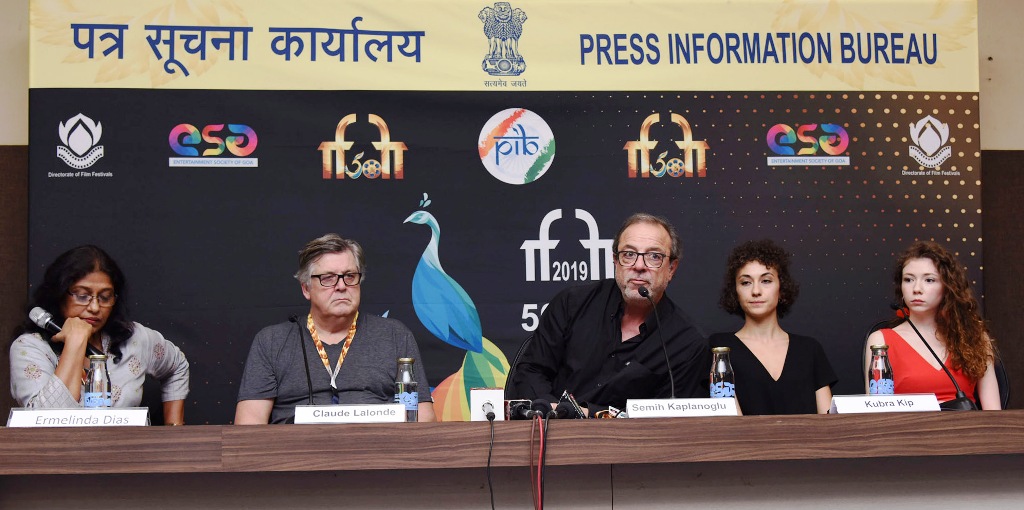
The Director of film ‘Commitment’ Semih Kaplanoglu, the Director of film ‘Coda’ Claude Lalonde along with Actress Kubra Kip and Ece Yuksel interacting with Media, at the 50th International Film Festival of India (IFFI-2019), in Panaji, Goa on November 22, 2019.
Goa: 20th November 2019: (PIB)::
Director of film ‘Son Rise’ Vibha Bakshi being felicitated, during the 50th International Film Festival of India (IFFI-2019), in Panaji, Goa on November 21, 2019
In the luminous presence of two stalwarts of Indian cinema – Shri Amitabh Bachchan and Shri Rajinikanth, the golden jubilee edition of the International Film Festival of India got off to a mesmeric start at Panaji, Goa. Ending the long wait of cinephiles across the world, 50th International Film Festival of India kick started in all its glitz and glamour.
At a grand ceremony hosted by the master of entertainment Shri Karan Johar, the great doyen of Indian cinema Shri Amitabh Bachchan and the ‘Thalaiva’ of Indian film industry Shri Rajinikanth flagged off the extravaganza and announced the festival open, in the presence of Union Minister for Information & Broadcasting Shri Prakash Javadekar and other official dignitaries. Shri Rajinikanth was conferred the 'Icon Of Golden Jubilee Award' for his outstanding contribution to Indian cinema, a first time award beginning with the 50th edition. One of French cinema's defining faces actress Ms. Isabelle Anne Madeleine Huppert was conferred with the Lifetime Achievement Award.
The Union Minister for Information & Broadcasting, Shri Prakash Javadekar while speaking at the inaugural ceremony said that single window system introduced by the government will attract more international filmmakers to shoot their films in India. “ India has lots of scenic and beautiful shooting sites for national and international films but shooting at these locations requires around 15-20 permissions. Government is now preparing for single window arrangement which will take care of all the permissions and it will benefit places like Goa, Leh-Ladakh and Andaman & Nicobar,” he said.
Shri Javadekar pointed out that films, IT and music are India’s soft power and we have to take it forward. “Every film and character leaves a long lasting imprint on our mind and it has the power to change our thoughts and mood” he said. He added that the audience for Indian films is growing by leaps and bounds and people across the world really like to watch Indian movies even in China.
“Many good films of the world will be showcased in this film festival and it will be a tribute to former Goa Chief Minister Manohar Parrikar,'' the Minister said. He mentioned about a film in the festival which has been made by local artists of Goa based on the lives of visually impaired people.
Receiving the 'Icon Of Golden Jubilee Award, Shri Rajinikanth expressed his happiness to receive the prestigious award from Shri Amitabh Bachchan. He dedicated the award to all the producers, directors and technicians who worked in his films, his fans and people of Tamil Nadu.
Shri Amitabh Bachchan expressing his happiness in being honoured stated, “I have no words to express my gratitude to IFFI for honouring me and having a retrospective of my films.”
Earlier, walking the Red Carpet of IFFI 50, Shri Amitabh Bachchan said, “ Films have always been an integral part of our social life. To have a festival of this magnitude in Goa exposes the Goans to what happens in the international world and also gives them an opportunity to meet and mix with people”.
The Secretary Information and Broadcasting Ministry, Shri Amit Khare mentioned the noteworthy highlights of this year’s festival and noted the tremendous change in the last 50 editions from a participation of 23 countries in 1952, to 76 countries this year.
The Chief Minister Dr. Pramod Sawant said that the IFFI package this year is an interesting mix of leisure and entertainment. “ IFFI bridges the gap between India and international film industry and provides the opportunity to explore the cinema,” he said. “We should not forget the objectives of cinema as the mirror of our time and the reflection of our society,'' he added.
Lights and luminaries of film industry such as world known Cinematographer and Chairman of IFFI International Jury John Bailey; Indian film maker, and Chairman of Indian jury Shri Priyadarshan and other jury members of Indian and International jury, Maria Lemesheva, Head of Russian delegation, graced the opening ceremony. A host of celebrities sashayed the red carpet, adding to the pomp and gaiety of the function.
As the festival glitters in its golden glory, former Goa Chief Minister late Manohar Parikkar, the man who made IFFI synonymous with Goa, was given a befitting tribute at the opening ceremony by screening a short film depicting his contribution to IFFI. Legends of Indian film industry Shri Ramesh Sippy, Shri N. Chandra and Shir P.C. Sreeram were honoured at the inaugural ceremony.
The inaugural ceremony of the festival also saw various senior official dignitaries such as Union Minister for AYUSH Shri Shripad Naik, Union Minister of State for Environment, Forest and Climate Change Shri Babul Supriyo, Secretary, Ministry of Information & Broadcasting Shri Amit Khare, Prasar Bharati Chairman Shri A. Suryaprakash, Central Board of Film Certification Chairman Shri Prasoon Joshi, Additional Secretary, Ministry of Information & Broadcasting, Shri Atul Kumar Tiwari, Festival Director Shri Chaitanya Prasad, and Vice Chairman Entertainment Society of Goa. Shri Subhash Phal Desai.
Shri Prakash Javadekar released the commemorative postage stamp of 50th IFFI at the function. The inaugural ceremony also witnessed some enthralling audio visual performances which kept the audience spellbound through the evening. Noted music singer and composer Shankar Mahadevan and his band won the hearts with a spectacular performance that put the cinelovers and spectators in a frenzy. When rhymes and rhythms from different parts of India juxtaposed with the beats of international sounds, it was a treat for the audience.
The festival opened with the Italian film ‘Despite the Fog’ directed by Goran Paskaljevic. The cast and crew of the film also participated in the screening. Around 7000 delegates are participating in the golden edition of IFFI.
The 50th International Film Festival of India 2019 will witness over 200 acclaimed films from 76 countries, with Russia as the country of focus. It also includes 26 feature films and 15 non feature films in Indian panorama section. More than 10,000 people and film lovers are expected to participate in the golden jubilee edition.The festival ends on Thursday 28 November, 2019, in Panaji, Goa. (PIB)
The Union Home Minister, Shri Rajnath Singh being presented a memento, during the Young Women Achievers Awards function 2017-18, organised by the FICCI, in New Delhi on April 06, 2018. (Photo and details by PIB)
Posted On: 22 MAR 2018 5:21PM by PIB Delhi India will be self-reliant in the production of silk by 2020
The Minister of Textiles Smt. Smriti Zubin Irani interacting with media today regarding efforts of the Govt. of India to make the country self-reliant in silk production
New Delhi: 22nd March 2018: (PIB//Punjab Screen Bureau)::
India will be self-reliant in the production of silk by 2020, said the Minister of Textiles Smriti Zubin Irani in a media interaction today. The Union Cabinet’s decision approving the Integrated Scheme for Development of Silk Industry will help increase the production of Bivoltine silk (high quality) by 62 percent by 2020. The Minister further said the aim of the government is to increase the number of people engaged in the silk sector from 85 lakhs to one crore in the next three years. She said, 50 thousand people will be trained in this sector. Smt. Irani told media that an inter- ministerial committee of related ministries will be set up under the Textiles Ministry to disburse a sum of Rs. 1000 crores for development of Research & Development.
Seed production units will be equipped and strengthened, besides increasing the production capacity to cater to the increased demand for silk in the future. Elaborating further the Minister said that under Digital India, web-based solutions will be provided to farmers engaged in seed production and other allied activities. Farmers and seed producers will get all subsidy by Direct Benefit Transfer.
The minister informed that market development is a very important area and 21 cocoon testing centres are being set up in the main silk producing states of the country. Apart from this, 19 basic silk seed farms, 20 silk worm seed production centres, 131 chawki rearing centres and 500 acres of land is being set aside for improved varieties.
Infrastructure development by individual farmers and silk producers will be financially supported by the Central Government which will bear 50% of the costs. For beneficiaries belonging to SC or ST category, the Centre will bear 65% of the cost. In case of beneficiaries from North East States, J&K, Himachal Pradesh, Uttarakhand, Jharkhand and Chhattisgarh, the Centre will bear 80% of the cost. A Helpline will be set up for timely redressal of grievances and all outreach programmes.
Smt. Irani informed that the State Governments have been urged to participate in implementing the Scheme as they have an important role to play in increasing the silk production of the country. The Minister said that out of 26 silk producing and consuming states, only 17 have a separate Department or Directorate of Sericulture.
The Minister of State for Home Affairs, Shri Kiren Rijiju meeting the Minister of State for Tourism (I/C) and Electronics & Information Technology, Shri Alphons Kannanthanam, in New Delhi on January 20, 2018.
10-March-2017 16:05 IST Steps taken by Government to curb the generation of black money
New Delhi:10th March 2017: (Punjab Screen Bureau)::
Action against black money is an on-going process. Such actions include policy-level initiatives, effective enforcement action on the ground, putting in place robust legislative and administrative frameworks, systems and processes with due focus on capacity building and integration and mining of information through increasing use of information technology.
Recent major steps in this regard include – (i) Constitution of the Special Investigation Team (SIT) on Black Money under Chairmanship and Vice-Chairmanship of two former Judges of Hon’ble Supreme Court, (ii) Enactment of a comprehensive law – ‘The Black Money (Undisclosed Foreign Income and Assets) and Imposition of Tax Act, 2015’ to specifically deal with black money stashed away abroad, (iii) Constitution of Multi-Agency Group (MAG) consisting of officers of Central Board of Direct Taxes (CBDT), Reserve Bank of India (RBI), Enforcement Directorate (ED) and Financial Intelligence Unit (FIU) for investigation of recent revelations in Panama paper leaks, (iv) Proactively engaging with foreign governments with a view to facilitate and enhance the exchange of information under Double Taxation Avoidance Agreements (DTAAs)/Tax Information Exchange Agreements (TIEAs)/Multilateral Conventions, (v) Proactively furthering global efforts to combat tax evasion/black money, inter alia, by joining the Multilateral Competent Authority Agreement in respect of Automatic Exchange of Information (AEOI) and having information sharing arrangement with USA under its Foreign Account Tax Compliance Act (FATCA), (vi) Renegotiation of DTAAs with other countries to bring the Article on Exchange of Information to International Standards and expanding India’s treaty network by signing new DTAAs and TIEAs with many jurisdictions to facilitate the exchange of information and to bring transparency, (vii) Enabling attachment and confiscation of property equivalent in value held within the country where the property/proceeds of crime is taken or held outside the country by amending the Prevention of Money-laundering Act, 2002 through the Finance Act, 2015, (viii) Enactment of the Benami Transactions (Prohibition) Amendment Act, 2016 to amend the Benami Transactions (Prohibition) Act, 1988 with a view to, inter alia, enable confiscation of Benami property and prosecution of benamidar and the beneficial owner, (ix) Initiation of the information technology based ‘Project Insight’ for strengthening the non-intrusive, information driven approach for improving tax compliance, and (x) Launching of ‘Operation Clean Money’ on 31st January 2017 for collection, collation and analysis of information on cash transactions, extensive use of information technology and data analytics tools for identification of high risk cases, expeditious e-verification of suspect cases and enforcement actions in appropriate cases, which include searches, surveys, enquiries, assessment of income, levy of taxes, penalties, etc. and filing of prosecution complaints in criminal courts, wherever applicable.
This was stated by Shri Santosh Kumar Gangwar, Minister of State in the Ministry of Finance in written reply to a question in Lok Sabha today.
The President of India, Shri Pranab Mukherjee opened the annual ‘Udyanotsav’ of the Rashtrapati Bhavan today (February 04, 2017)
The President, Shri Pranab Mukherjee opens the annual “Udyanotsav” of the Mughal Gardens of Rashtrapati Bhavan, in New Delhi on February 04, 2017.
The Mughal Gardens will remain open for general public from tomorrow to March 12, 2017 (except on Mondays which are maintenance days) between 0930 hrs to 1600 hrs. Members of the public will also be able to visit the Spiritual Garden, Herbal Garden, Bonsai Garden and Musical Garden. During this period, there will be no online booking for visiting the Gardens.
Entry and exit for the general public will be from Gate No. 35 of the President’s Estate, close to where North Avenue meets Rashtrapati Bhavan. Visitors are requested not to bring any water bottles, briefcases, handbags/ladies purses, cameras, radios/transistors, boxes, umbrellas, eatables etc. Such articles, if any, will have to be deposited at the entry point. However, arrangements of drinking water, toilets, first aid / medical facility; rest rooms for senior citizens, women and children will be provided for public visiting the Gardens.
The Mughal Gardens will be open exclusively on March 10, 2017 to special category of visitors viz farmers, differently abled persons, defence/para-military forces and Delhi Police personnel from 0930 hrs. to 1600 hrs. Entry and exit will be through Gate No. 35.
The Tactile Garden will be open for visually impaired people on March 10, 2017 from 1100 hrs. to 1600 hrs. Entry and exit will be fromGate No. 12, situated on Church Road (next to the North Avenue). (PIB)
Ministry has approved 3 Mega Food Parks in the state
Ludhiana: 26 September 2016:: (PRD//PIB//Punjab Screen)
Union Minister for Food Processing Industries Mrs Harsimrat Kaur Badal and Punjab Deputy CM Mr Sukhbir Singh Badal today laid the foundation stone of Mega Food Park at village Ladhowal, near here. This is the first of its kind Mega Food Park of the state, which is being developed by the Punjab Agro Industries Corporation of the Punjab government.
While speaking on the occasion, Mrs Harsimrat Kaur Badal suggested that this project be named as "Gurkirpal Mega Food Park" because the speed at which Punjab has witnessed all-round record development is due to the "Kirpa" of our "Guru". She said that this Multi Product Mega Food Park is the gift of the Prime Minister Mr Narendra Modi to Punjab and will give benefit to farmers and processors of Ludhiana, Fatehgarh Sahib, Rupnagar, Shaheed Bhagat Singh Nagar, Jalandhar, Moga, Sangrur and Barnala districts of the state.
Mrs Badal informed that this Mega Food Park will be set up with the project cost of Rs 117.61 crore in an area of 100.20 acres. The park will have facilities of 500 kg/Spiral Freezer, 1000 MT Cold Store of Onion and Garlic, 1000 MT Frozen cold store of Vegetable produce, 10000 MT Dry Warehouse, 10000 MT Silos, 100 MT Ripening Chamber (ECRC), 1 MT/Hr Dehydration Line (Air dried), 400 MT Cold Storage, Reefer Vans, Food Incubation Center (ICRESAT) and Testing Laboratory.
While providing further information, Mrs Harsimrat Kaur Badal said that in order to give an impetus to the growth of the Food Processing Sector in Punjab, Ministry has approved three Mega Food Parks in the state. Out of these three, first Mega Food Park at Fazilka has already become operational, the foundation stone of a second Mega Food Park promoted by Punjab Agro Industries Corporation Ltd was laid today and the third Mega Food Park (M/s Sukhjit Mega Food Park) has been approved by the Ministry in Kapurthala District, the foundation stone of which would be laid next month.
She further stated that under the visionary guidance of Prime Minister Mr Narendra Modi, Union Ministry of Food Processing Industries is focusing on boosting the Food Processing Industry so that agriculture sector grows exponentially and becomes the engine of growth to drive the “Make in India” initiative of the Hon’ble Prime Minister. Ministry of Food Processing Industries has identified creation of modern infrastructure for food processing as a focus area and is encouraging private investment. As a step in this direction, Ministry of Food Processing Industries has been implementing the Mega Food Park Scheme in the country to give a major boost to the Food Processing Sector along the value chain from the farm to the market with strong forward and backward linkages through a cluster based approach.
Further providing information about this Mega Food Park at Ladhowal (Ludhiana), she stated that it would be treated as a central processing centre and four primary processing centres- at Hoshiarpur, Amritsar, Fazilka and Bathinda would also be set up. She said that this project would not only help the farmers, but would also generate job avenues for our youth.
While speaking on the occasion, Deputy CM Mr Sukhbir Singh Badal said that this Mega Food Park project will create a modern infrastructure for arresting post-harvest losses of horticultural and non-horticultural produce and provide impetus to the growth of food processing sector in Punjab. This Mega Food Park project will help in providing better prices to farmer, reduce wastage of perishables, add value to agricultural produce and create huge opportunities for entrepreneurship and employment for the youth of the state. He said that more than 40,000 farmers would be benefited from this project and more than 10,000 youth would get employment.
Later, while speaking to media persons, Mr Sukhbir Singh Badal said that during the last 9 years, the state has witnessed record development in all fields and during the rule of Capt Amarinder Singh, there was not even a single project which the Congressmen can claim as their achievement. He said that the Congress has already conceded defeat and SAD-BJP would form government for the third time a row due to its record development. While terming Aam Aadmi Party as Anti-Punjab, he said that like the Congress, even AAP cannot boast of any of their achievements, because there is none. He also said that the formation of any political front would not have any impact on the SAD-BJP combine.
Minister of State for Food Processing Industries Sadhvi Niranjan Jyoti also termed this Mega Food Park as a gift for the Punjabis and said that it would boost the economy of the state. She alleged that it was due to the anti-farmer policies of the UPA government that the farmers are suffering. Agriculture Minister Mr Tota Singh also thanked the Union Government and Union Food Processing Industries Minister Mrs Harsimrat Kaur Badal for this project.
Prominent among those present on the occasion included Irrigation Minister Mr Sharanjit Singh Dhillon, Advisor to CM Mr Mahesh Inder Singh Grewal, MLA's Mr Darshan Singh Shivalik, Mr Manpreet Singh Ayali, Mr Ranjit Singh Dhillon, Mr SR Kler, Punjab Agro Industries Corporation Chairman Mr Amrik Singh Aliwal, Punjab Agro Foodgrains Corporation Chairman Mr Dyal Singh Kolianwali, Punjab Subordinate Services Selection Board chairman Mr Santa Singh Umedpuri, former minister Mr Hira Singh Gabria, ex MLA's Mr Ranjit Singh Talwandi and Mr Jagjiwan Singh Khirnia, Mr Madan Lal Bagga, Mr Harbhajan Singh Dang, BJP District President Mr Ravinder Arora, Mayor Mr Harcharan Singh Gohalwaria, MD Punjab Agro Industries Corporation Mr Kahan Singh Pannu, Deputy Commissioner Mr Ravi Bhagat, besides several others.